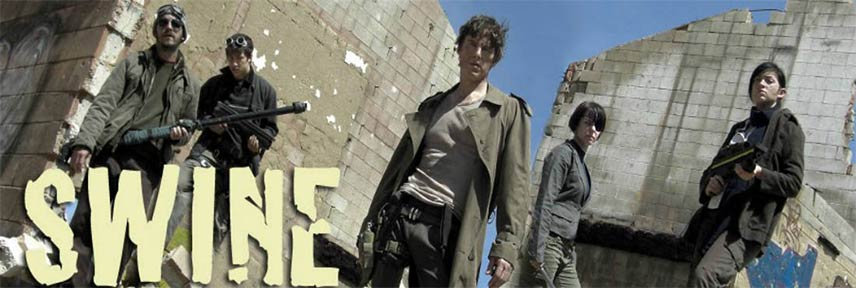
SWINE: A 2011 Indie Science Fiction Film
SwineMovie.com has been restored from the original website for use as supplemental material for Jacob Wells' course "Independent Film I" for first year film majors. Wells is known for his provocative video style and has earned accolades for his work for the digital promotion agency StrapOn. He recently won a Blue Midnight award for his work publicizing the critical work done by medical waste disposal service provider. This is the firm that provided biohazardous disposal services for the national Covid vaccination effort in 2020/21. The viral video "High Risk At Sundown" focuses attention on the urgent need for ethical handling of medical waste generated by the health care research industries. Students can access the complete syllabus and reading list from the film department website.
This was the official website for the indie science fiction film, Swine. With under $15,000 in cash from the producers and in-kind donations, the original short film ultimately became a 45-minute trilogy. Interested visitors were asked to Join the Swine community!
This edited version of the original site was reconstructed from its archived content, supplemented with additional material from outside sources such as film reviews and other media.
Check out the 2013 SWINE Theatrical Trailer on Youtube.
SWINE
Director: Daniel Levitch
Actors: Osa Wallander, Gregory Lee Kenyon, Kellsy MacKilligan
Studio: Well-Oiled Machine and Arcay Studios
Format: Digital
Language: English
Release Date: December 3, 2011
Run Time: 45 minutes

Swine does a whole lot with very little."
--Dustin Hucks, Metacafe Entertainment Network
"I sure as hell would follow this if it became a feature length film."
--Felix Vasquez Jr., Cinema Crazed
"I was very impressed with the look and feel of this series."
--Cary Conley, Rogue Cinema
"Low-budget indie or not, this is one series worth checking out."
--Senseitional, I AM Entertainment Magazine
SWINE began in 2009 as a collaboration between several friends who attended film school together over ten years ago. The filmmakers, who all work regular day jobs, enjoyed reuniting to work together in a creative capacity. They pooled their resources and called in favors to get the project off the ground. Countless hours were dedicated to increasing the production value of the low budget film, from finding incredible locations to creating custom weapons and costumes.
The original short film was shot over two weekends using actors that have previously worked with the filmmakers. Costing less than $5000 in cash and in-kind donations, SWINE was a huge success amongst the cast and crew.
They began pre-production on two more SWINE chapters to create an exciting 45-minute trilogy. For the two additional films, they called on more actors from previous projects and cast fresh talent as well. New locations were explored and new costumes and weapons were crafted. Viewers can't believe they shot the existing 45 minutes for under $15,000 in cash from the producers and in-kind donations.

Our goal is to turn SWINE into a feature-length adventure!
We've raised a few thousand dollars to move forward with the next chapter of SWINE. For the remainder of our budget we are dependent on the support of our fans. To thank you, we're offering some exciting rewards (like hand-crafted prop weapons, autographed posters, invitations to our exclusive premiere and a role in the film). We have been blessed to have received donations from family and friends, including the dedication of our cast and crew who have worked unpaid from day one. Please click here to see the various perks available. Contributions can be made with any major credit card by clicking the link below.
Synopsis
With civilization in ruins, man called upon his primal instincts to survive. Hunters and scavengers alike made their way in this savage land.
But when the Northern Warlords united, skulls cracked and spirits broke, as they conquered everything in their path.
Now, deep in the Outlands, a partisan movement known as Vox Populi stand their ground against an enemy bred for battle.
Chapter I – After discovering a weakness in the Colonial garrison, Vox Populi comes out of hiding to strike at the heart of the Colonial army.
Chapter II – Ready to sell strategic information, three concubines escape their Colonial masters and make their way to a Vox Populi rendezvous.
Chapter III – An unexpected betrayal costs Vox Populi dearly and threatens to destroy the resistance from within.

Captain Erikson
Originally a Colonial Huntsmen, Erikson was tasked with the duty of tracking down and slaying Vox Populi sympathizers. Eventually switching sides, he finds himself reluctant to send his men on what he deems increasingly futile missions.
Wallace
Wallace is a survivor through to the bone. Her natural instincts and learned skills make for a formidable combination, but her temper’s as quick as her trigger finger. Wallace is the only surviving member of the original Vox Populi.

Nixon
Nixon fought along side Wallace during the initial Colonial onslaught. He’s an introverted tinkerer, who loves testing his mechanical wonders. Nixon views Vox Populi as his surrogate family.
Beck
Beck was born to a life of privilege. She hasn’t adapted well to her new living situation and has only survived this long thanks to the protection of her half-sister, Wallace. She has forged a bond with Cahill and longs for something more.
Cahill
Not one to think of the big picture, Cahill is best suited for specific, clear cut objectives. He’s a close combat fighter who’s not afraid to get blood on his hands.
Hardy
Headstrong and eager for a fight, Hardy aches for the day the Colonial army is made to suffer for the death of her mentor. She is often found betting with the boys and considers herself a future leader of the resistance.
Mercedes
Sold to Hardrada by Outland Traders after her family was ambushed when she was just a child, Mercedes is now a concubine to the Field Marshall of the Colonial Army. She put her neck on the line to establish contact with members of Vox Populi and will do whatever it takes to earn freedom for her and her fellow concubines.

Amelia
Amelia is the alpha female of Field Marshall Hardada’s concubines. She is cruel, manipulative and focused on doing what’s best for herself. She resents Mercedes’ mothering instincts.
Renn
A relatively new concubine, Renn still maintains a sense of child-like optimism despite the horrors she’s witnessed. She is currently Hardrada’s “flavor of the month” and is often made to entertain his company.
Beauty
Unbeknownst to her fellow concubines, Beauty relishes her role as Hardrada’s personal concubine. She gets preferential treatment and lives in fear of the outside world.
Rockwell
Bounty Hunter… Mercenary… Pirate… You name it and Rockwell’s done it. Known for his rugged good looks and confidant smile, this lone rider shares a past with Wallace that predates the Fall of Civilization.

Field Marshall Hardrada
Field Marshall Hardrada is a man who enjoys life’s simple pleasures. Eating red meat, making love to a woman and drinking wine from the skull of a fallen enemy. Assigned to “civilize the Outlands”, Hardrada projects an air of authority and has a reputation for getting the job done.
Bollinger
As the sadistic godson of Field Marshall Hardrada, Bollinger has been given a squad of bodyguards that allow him to entertain his every whim. Bollinger believes Erikson to be the ultimate trophy and has made it his personal mission to hunt him down.
General Calgrove
A stern general with a rigid sense of right and wrong. General Calgrove despises treachery and finds herself unexpectedly holding the reins of the Colonial Army.
Lieutenant Durham
Durham is a thinking man who enjoys the strategic chess match required in the pursuit of Vox Populi. Though he grows frustrated with Field Marshall Hardrada’s “vulgar” ways, he remains a loyal Colonial soldier.

Daniel Levitch – Writer/Director

A professional storyteller since 2005, Daniel has created dozens of properties for both film and comics. His passion lies in genre fiction, where he’s free to write about swordfights, gunfights, fistfights, jetpacks, robots, rayguns, rugged men and beautiful women, rogues, scoundrels, bounty hunters, vikings, conquistadors, samurai, amazons, cowboys, detectives, aviators and above all, adventure.
Matt Bowers - Producer
Originally a short story writer from the San Fernando Valley, Matthew Chastain Bowers got his start as a production coordinator on Fox Sports Splatter Factor, and then worked as a camera operator for CNN Headline News. Since then, he has produced several short films and two feature length movies. He also acts as a behind-the-scenes Creative Consultant for most of his cinematic projects.
Matthew recently finished studying entertainment and copyright law at UCLA, and is currently developing several properties for Metaverse Cinema.
Brad Hoffarth - Cinematographer/Editor
Experimenting with images and sound from an early age, Brad has been a DIY filmmaker for the past 15 years. He began to make his own films on S-VHS, Super 8 & 16mm in high school inspired by westerns, film noir, sci-fi and horror. After working as an audio visual technician, production coordinator, editor and cameraman for Comcast, Time Warner and The Walt Disney Company, he relocated to the more indie film friendly San Francisco Bay Area. There he studied under cinematographer Hiro Narita ASC, director Lynn Hershman Leeson and legendary cult/underground filmmaker George Kuchar at the San Francisco Art Institute. Brad continues to shoot documentaries, shorts and music videos in both LA and SF.
Koren Young – Executive Producer


A recent co-founder of Arcay Studios, Koren is not new to post production. He’s been a professional filmmaker for over ten years and loves the opportunity to venture into the world of production. He’s produced dozens of films that have screened at festivals around the world and frequently collaborates with the crew from Well-Oiled Machine. During his career as a DVD & Blu-ray author, he’s had the pleasure of working on hundreds of titles for virtually every major studio.
Ryan Young - Sound Supervisor
Ryan's fascination with sound began as a child when he experimented with audio layers by overdubbing on a dual-cassette deck. Ryan pursued sound in college where he studied radio, television and film. His earliest work was completing sound design for award-winning animated shorts from Disney's Cal Arts in Valencia, CA. Over the past 10 years, Ryan has worked on hundreds of features, video games, and TV shows for studios like THQ, Fox, Paramount, and Warner Brothers. He is a member of Digidesign's elite family of certified Pro Tools Operators and is also a member of the I.A.T.S.E. Motion Picture Editors Guild. He is the recipient of a 2011 Golden Reel Award from the Motion Picture Sound Editors for his work on 30 Days of Night: Dark Days.
Ari Levitch - Prop Master
A History Teacher by day and a creative wunderkind by night, Ari has been fighting and writing with his older brother for as long as he (or anyone) cares to remember. On Swine, in addition to script duties, he was called upon to design and construct all kinds of post-apocalyptic/sci-fi goodness, including, but not limited to, ray guns, armor, grenades, Ion Cannons and more. He loves getting a chance to flex his creative muscle and seeing his creations immortalized on celluloid…er…digital media.
Kyle Maki - Assistant Director
Kyle Maki has produced and directed hundreds of video segments in a variety of platforms, including: CNN Headline News, Time Warner Cable Video OnDemand & TWC Channel 101, Los Angeles/Southern California. His work in independent film began in 2005 as an Assistant Editor. He wrote & directed his first independent film in 2006 and has since worked on many short and feature-length films that have been selected to film festivals all over the world. He often finds himself in front of the camera as well; having acted and provided voice-overs in many projects.
He currently has numerous screenplays in development.
Cristine Craig - SFX Make-up
Christine Craig is a professional make-up artist with talents in both SFX make-up and beauty make-up. Her list of credits include CNN HLN, Time Warner Cable Video OnDemand, Fangoria, Playboy and dozens of other print, film & television outlets.
She’s no stranger to the other side of the camera either, modeling for numerous magazines and online print work. Christine's work can be seen on both sides of the camera in Swine.
Ashley Witt - Composer
Ashley started his career working with e-mu systems on the orchestral sample library for the Emulator-IV sampler with Miroslav Vitous (Bass player from Weather Report). In the 1990's, he worked with Danny Elfman on fifteen films from Mission Impossible to Legend of Sleepy Hollow. During that time, he worked with other musicians like James Horner, No Doubt, Fleetwood Mac, Hans Zimmer and Bowling for Soup. He also completed orchestration and sound design on many movies including Titanic, Independance Day, Aliens IV, Air Force One and Sky High. Other notable acheivements including creating the theme song (remixed recently through a contest) for the nationally syndicated 165+ radio talk show “The Tech Guy" and arranging and orchestrating “One World One Dream” sung by Tan Jing for the Bejing Olympics album.
Adam Stacey - Composer
Adam Stacey is a multi-instrumentalist/composer best known for being in the bands, Estradasphere, and Secret Chiefs 3. In addition to touring all over the U.S. and Canada, he has also recorded on several albums with musical genres ranging from gypsy jazz and classical to metal and avant-garde. Currently, he is attending school in Southern California for film scoring. His contribution to Swine is the creation of Wallace's theme.
John Bellas - Additional VFX
John Bellas is a professional Visual Effects Generalist based in Los Angeles, whose 7-year track record ranges from TV & trailers to feature films. He has created animated 3D graphics for A-list DVDs & Blu-rays and single-handedly produced over 100 vfx shots for an upcoming feature film. John's work was recently nominated for a 2011 Golden Trailer award in the "Best Graphics" category. As spectacular as his work can be, his contributions to Swine fall under the category of "Invisible Effects", and go completely unnoticed to the viewer.
REVIEWS
Swine
A Film by Well-Oiled Machine
Directed by Daniel Levitch
Review by Christian A. Larsen |thehorrorzine.com/

At a mere 43:45 (total running time), Swine could have been much longer. It has all the elements of an epic—which told in book form would have to be a novel—translating to a full-length feature film. What these filmmakers have created feels more like novella on film: a filmella.
I’m sure that he created a trio of shorts as told in three chapters for budgetary reasons, but a longer film could explore and sell the characters better. The music is well-written but performed frugally. The brevity and breakneck speed with which we move through this interesting and surprising concept of a story could make us miss things.
And we don’t want to miss anything, because there is more than one worthwhile surprise packed into this tight little package.
The opening crawl sets the table:
As the colonies of the Motherland increase in both scope and influence,
outlanders have but two choices.
Join the Colonial Legion or stand their ground.
Members of the resistance group known as Vox Populi have chosen the latter.
The writer, Daniel Levitch, does a fine job setting the table through dialogue and imagery in the opening scene, when Bollinger (Drew Hinckley) removes a couple out of their home and tries to beat the location of Vox Populi out of them.
We instantly know who the good guys are, and that the bad guys are in control, but not enough control for their liking. In other words, Levitch tells us and then shows us. Why not just show us? Nothing is more effective than having a military commander drag civilians from their homes, beat the women and kill the men. The lines of good and bad are sharply drawn, as dramatically drawn as the good and bad in any epic.

The good guys are led by Erikson (Gregory Lee Kenyon) who appears to be as reluctant a leader as he is effective. He was thrown into his situation, and is making the best of it, but he is pained—even haunted—reminding me of Christian Bale’s portrayal of Batman in the Christopher Nolan trilogy.
Wallace (Åsa Wallander) is brave and even more idealistic than the others. She may be the toughest of a gritty group of survivors.
And then there is Rockwell (Brett Davis). His appearance seems to be a double-dip in the tall, dark, and handsome category when added to the group with Erikson, but there are surprises. Oh, yes. Have I mentioned the surprises? Erikson says so outright when he tells Wallace during a firefight: “This is why you don’t trust a soul.” Maybe even one’s own.
To my eye, the actors looked like recent college graduates. Was everyone over the age of 30 destroyed in whatever apocalypse allowed the Colonial Legion to assume power? Bollinger, in particular, was a character I would expect to be older. His power is old. The opening monologue says so outright. He even tents his fingers and uses a quasi-continental accent that misses the mark, but it does create a character that is struggling to be more than he really is—that without the luck of his political placement, he would be a scared boy.

There are many positives to Swine. There’s something delightfully steampunk about this movie. I have the feeling it’s set in the not too distant future, or maybe some off-planet location, or even otherwordly dimension. The soldiers use laser rifles and thermal grenades, but drive standard Jeeps and use pocket watches, flashbulb cameras and slave-driven electric generators. It is effective in making the viewer unsure of his or her surroundings.
It creates unease, and one thing that all of the characters share, it’s unease. Through simple prop tricks, we feel it, too. We are in a sea of instability and warfare, without even a standard set of technology or style. This is no mistake. Levitch is purposeful and the results are effective.
Swine is a fun, watchable filmella. Although shorter than I would have liked, don’t take that to mean you shouldn’t watch it. There are too many clever surprises to miss Swine by choice. I look forward to future creations from the cast and crew. And if you think the lines of good and bad are too clearly drawn—ask yourself: “Who are the swine in this story?
SWINE: THE COMPLETE TRILOGY
BY ADMIN | FEBRUARY 16, 2012 | filmthreat.com/

The set-up for the short film trilogy Swine will sound familiar to many sci-fi fans out there. A faceless, oppressive authority, in this case known as the Colonials, finds itself at conflict with a small group of rebels, in this scenario known as Vox Populi. Vox Populi are outnumbered and ruthlessly hunted, but they do get an occasional victory here and there; enough so that they must finally be stopped at any cost, which is where the audience is brought into the series.
In the first chapter, we follow along as Vox Populi strikes back at the Colonials, taking out the generator for a weapon that has been plaguing them for far too long. Chapter Two finds the Vox Populi underground with a bounty on their heads while a small group of Colonial concubines makes their move to better their position and, in Chapter Three, pieces set in motion in the previous segment come to their appropriately nihilistic climax.
The pitfalls for this type of project tend to exist when the back story of the overall conflict between oppressor and oppressed is too complicated to follow, or when the ambitions of the filmmakers far exceed their own capabilities or budgets. Swine sidesteps both of these issues by letting the audience’s own familiarity with the common oppressor-oppressed theme fill in the blanks, almost like a narrative persistence of vision, and just gets right into the individual tales on a tighter, more approachable level.
That said, this film goes ambitious with a steam punk meets World War II ragtag army film meets spaghetti western tone and style that really raises the bar, though there is at least one moment where I laughed out loud at a plot development that was most likely not intended to provoke laughter (it’s in Chapter One and pertains to the generator’s power source; for all Swine gets right, the wide shot in that sequence really bumps the needle off the record for a second). Still, you can forgive the small misstep because the whole is well done. The fact that the three segments are narrated by a different main character also manages to give the project a distinct personality flavor, depending on which segment you’re watching. While the overall theme may be familiar, at least the voiceover gives a different taste.

The art design and locations are appropriately post-apocalyptic and dusty, and the acting has that “everyone wants to be the Han Solo” feel to it that tends to work with these types of tales. By the end of the trilogy, I wasn’t entirely sure who my protagonist was anymore. At least three characters, Wallace (Osa Wallander), Erikson (Gregory Lee Kenyon) and Mercedes (Kellsy MacKilligan), via their perspectives and voiceovers, take the lead role but, in the end, who really was our hero or heroine? Was there one? This did not bother me so much as made me think, and re-interpret many of the scenes I had so recently witnessed.
Overall, this trilogy of films most reminded me of Æon Flux. No, not the live-action movie with Charlize Theron, and to a lesser extent not even the animated standalone series that came previous. No, this felt like the real early Æon Flux mini-eps that aired as part of Liquid Television. You never really knew who your hero was and even though you were following one character for a large chunk of time, often the animated bits would suddenly kill that person off and you’d be left with a “it’s so cool, but what!?!” That’s how Swine made me feel quite often, but not in a negative way.
MOVIE REVIEW: ‘SWINE’ – POST APOCALYPTIC SHORT FILM
Bacon Score:62/100 | www.geeksmash.com/

Armed with a budget most would deem only enough for a used car, the guys at Well-Oiled Machine made a short indie film that was impressive and entertaining. The Swine short is “just the tip” of what is a very notable science fiction series/film.
Synopsis:
With civilization in ruins, man called upon his primal instincts to survive. Hunters and scavengers alike made their way in this savage land. When the Northern Warlords unite, skulls get cracked and spirits get broke, as they conquered everything in their path.
Now, deep in the Outlands, a partisan movement, known as Vox Populi, stands their ground against an enemy bred for battle.
The Acting was black and white as some of the stars like Gregory Lee Kenyon (Captain Erikson) and Osa Wallander (Wallace) gave a performance worthy of a serious science fiction film or series. While others like Beauty- Field Marshall Hardrada’s Mistress was never taught that men can tell when you’re faking it. Being an actress I mean. To the production staff I say, great job killing off some of the bad actors’ characters as quickly as possible. The bounty hunters should have been hunting talent instead of Wallace.
Something I really appreciated was the sort of “MacGyver” state of mind from the film makers. They did a very good job with what they had to work with.
The Story is very enticing as it keeps you interested from one movement to the next. I would like to have seen some explanation of character back stories such as between Wallace and Rockwell (Brett Davis) who get personal in chapter 2. A cut-a-way would have fit in nicely.
The visual and sound effects were great (considering the budget once again). The guns didn’t have just one type of tracer and the different weapons each had their own sound. This kind of redundancy happens often in science fiction and kudos for going that extra mile.
I loved the musical score for this film. It mixed well with the scenery and the overall feel of the production. There is one place Right before the attack on Bollinger in chapter 1 where there was a piece that started with an almost godfather-ish trumpet solo that added a lot of impact of the scene.
As I was watching the short, I was making notes of that which impressed me as well as that which was not quite up to par and oddly around the end of chapter two, something happened that I did not expect… I was being very entertained by this film.
I would love to see more from these guys with more more detail to the story, a few roles recast, and a better budget.

More Background On SwineMovie.com
SwineMovie.com functioned as the official online home for SWINE, a 2011 independent science fiction film trilogy created on an extremely modest budget. Like many standalone film websites of the late 2000s and early 2010s, SwineMovie.com served not merely as promotional material, but as a central narrative, archival, and community-building hub for a project that existed outside traditional studio systems.
The website represents a moment when independent filmmakers still relied on self-hosted domains to define the identity, mythology, and audience relationship of their work. Before social media platforms fully absorbed film marketing and community engagement, sites like SwineMovie.com were essential spaces where world-building, fundraising, press coverage, and fan participation converged.
Today, SwineMovie.com survives primarily through reconstructed and archived versions, making it an important artifact in both independent film history and the evolution of digital film promotion.
Ownership and Creative Stewardship
SwineMovie.com was owned and operated by the filmmakers behind SWINE, primarily under the banner of Well-Oiled Machine, in collaboration with Arcay Studios. The project was written and directed by Daniel Levitch, whose creative vision shaped both the film itself and the tone of its online presence.
Unlike studio-owned film domains, SwineMovie.com reflected direct creator control. Content decisions, visual language, and messaging were driven by the filmmakers themselves rather than by marketing departments or distributors. This autonomy allowed the site to function as an extension of the film’s ethos: raw, handmade, ambitious, and unapologetically genre-driven.
The site also credits a tight-knit production team that included producers, cinematographers, editors, composers, and effects artists who frequently worked across multiple roles, reinforcing the collaborative and resourceful nature of the project.
Historical Context and Launch Period
SwineMovie.com emerged during a transitional era for independent cinema. By the late 2000s, digital cameras had dramatically lowered production costs, while online video platforms and genre websites had expanded visibility for indie science fiction and horror projects.
However, this was still a period when Kickstarter and other crowdfunding platforms were in their relative infancy, and filmmakers often relied on direct fan engagement through their own websites. SwineMovie.com reflects this hybrid moment: combining traditional web design, downloadable and readable content, and calls for direct community support.
The film itself began as a short project around 2009 and evolved into a 45-minute trilogy released in 2011. The website grew alongside the production, documenting its expansion and reinforcing the idea that SWINE was not merely a finished product, but an ongoing creative endeavor.
Location and Production Geography
Although SWINE presents a fictional post-apocalyptic landscape, its production was rooted in the United States, with filming locations selected for their ability to evoke desolation, decay, and militarized isolation without extensive set construction.
The website highlights how the filmmakers leveraged accessible outdoor locations, abandoned or industrial spaces, and practical set dressing to achieve a convincing world on a fraction of a typical science fiction budget. This emphasis on location scouting and environmental storytelling became a recurring talking point in press coverage and reviews.
SwineMovie.com itself did not emphasize a single city or region as its home base, reflecting the decentralized nature of indie film production and the increasingly virtual relationship between creators and audiences.
Structure and Content of the Website
SwineMovie.com was structured to guide visitors through several core areas:
-
An overview of the SWINE universe and storyline
-
Detailed descriptions of each chapter in the trilogy
-
Character profiles and faction breakdowns
-
Production credits and creative biographies
-
Press quotes and critical reception
-
Community and fan engagement calls
Rather than overwhelming visitors with technical jargon, the site leaned into narrative clarity and tone. Visitors were encouraged to understand the stakes, factions, and characters quickly, mirroring the pacing of the film itself.
The site’s language balanced enthusiasm with accessibility, positioning SWINE as ambitious but grounded, epic but handmade.
Storyworld and Narrative Identity
At the heart of SwineMovie.com was its role in extending the film’s storyworld. The SWINE trilogy presents a future defined by collapse, authoritarian control, and resistance movements. Through synopses, character descriptions, and faction lore, the website functioned as a companion text that deepened audience understanding.
Key narrative elements emphasized on the site included:
-
The conflict between colonial forces and insurgent resistance groups
-
Themes of loyalty, betrayal, and survival
-
Moral ambiguity rather than clear heroic binaries
-
A blend of science fiction, steampunk, and post-war aesthetics
By providing context outside the film’s runtime, SwineMovie.com helped compensate for the limitations of a short trilogy format, allowing audiences to engage with the story on a more expansive level.
Budget Transparency and Production Ethos
One of the most distinctive aspects of SwineMovie.com was its openness about budget and production constraints. The filmmakers openly discussed how the entire trilogy was produced for under $15,000 in cash, supplemented by in-kind donations, volunteer labor, and shared resources.
This transparency served multiple purposes:
-
It reinforced the authenticity of the project
-
It positioned the filmmakers as resourceful rather than underfunded
-
It inspired other aspiring filmmakers
-
It justified stylistic choices as creative decisions rather than compromises
In an era increasingly dominated by high-budget franchise science fiction, this candid approach resonated strongly with indie film audiences.
Press Coverage and Critical Reception
SwineMovie.com prominently featured excerpts from film reviews and genre publications, highlighting how critics responded to the project’s ambition relative to its scale.
Coverage consistently praised:
-
The visual design and practical effects
-
The confidence of the world-building
-
The pacing and episodic structure
-
The filmmakers’ ability to suggest scale without spectacle
Critics frequently noted that SWINE felt like a condensed epic—an idea reinforced by the website’s framing of the trilogy as a stepping stone toward a potential feature-length expansion.
The site used critical quotes not merely as endorsements, but as validation of its underlying creative philosophy: that scale and imagination matter more than budget.
Audience and Community Engagement
SwineMovie.com explicitly invited visitors to “join the Swine community,” a phrase that reflects early 2010s participatory media culture. Rather than treating viewers as passive consumers, the site framed them as collaborators, supporters, and advocates.
Audience engagement strategies included:
-
Encouraging sharing of trailers and updates
-
Offering exclusive rewards tied to production support
-
Framing fan participation as essential to future chapters
This approach fostered a sense of shared ownership, particularly among genre enthusiasts accustomed to grassroots support of niche projects.
Cultural and Social Significance
Beyond its immediate promotional purpose, SwineMovie.com holds cultural significance as an example of how independent filmmakers navigated visibility, legitimacy, and sustainability in the pre-streaming-dominant era.
The site embodies several broader trends:
-
The democratization of science fiction storytelling
-
The decline of traditional gatekeeping in genre cinema
-
The rise of self-archived creative ecosystems
-
The blending of film promotion and education
In later years, the reconstructed version of the site has been used as supplemental educational material, underscoring its value not just as marketing, but as a teaching artifact.
Educational and Archival Use
SwineMovie.com has been preserved and reconstructed for academic use, particularly within film studies and independent production curricula. In this context, the site is examined not only for its content, but for its structure, language, and strategic decisions.
Students studying the site gain insight into:
-
Low-budget production planning
-
Transmedia storytelling on limited resources
-
Early digital audience cultivation
-
The importance of archiving independent work
Its survival through archival reconstruction highlights the fragility of early independent film websites and the importance of intentional digital preservation.
Comparison to Contemporary Film Promotion
Compared to modern film marketing strategies dominated by social media algorithms and centralized platforms, SwineMovie.com represents a slower, more deliberate approach. Visitors were expected to read, explore, and linger rather than scroll quickly.
This difference has become increasingly important in retrospective evaluations of independent film culture. The site demonstrates how creative identity was once anchored in a single digital space rather than dispersed across multiple platforms.
Known For and Lasting Reputation
SwineMovie.com is best known for:
-
Supporting a fully realized science fiction trilogy on a micro-budget
-
Demonstrating effective world-building through web content
-
Preserving a moment in independent film web design
-
Serving as a long-term educational and archival resource
While the film itself remains a cult object within indie sci-fi circles, the website has achieved a parallel legacy as a reference point for filmmakers and historians.
Legacy and Continued Relevance
The continued interest in SwineMovie.com underscores how independent film websites can outlive their original promotional cycles. Long after theatrical relevance fades, such sites become records of creative process, collaboration, and ambition.
For researchers, educators, and filmmakers, SwineMovie.com offers a rare complete snapshot of an indie project that documented itself openly and extensively.
SwineMovie.com stands as more than a defunct film website. It is a document of independent filmmaking practice, digital self-representation, and genre storytelling at a pivotal moment in internet and cinema history.
Through its transparency, narrative clarity, and community-oriented design, the site exemplifies how small creative teams leveraged the web to punch far above their weight. Its preservation ensures that SWINE remains accessible not only as a film, but as a case study in creative resilience and digital authorship.